For a long time, the goal of SEO was fairly clear.
A person searched on Google. Your website appeared in the results. They clicked, visited your page, read your content, explored your services, and perhaps contacted you, booked a call, bought a product, or requested a quote.
That journey still exists, but it is no longer the only one.
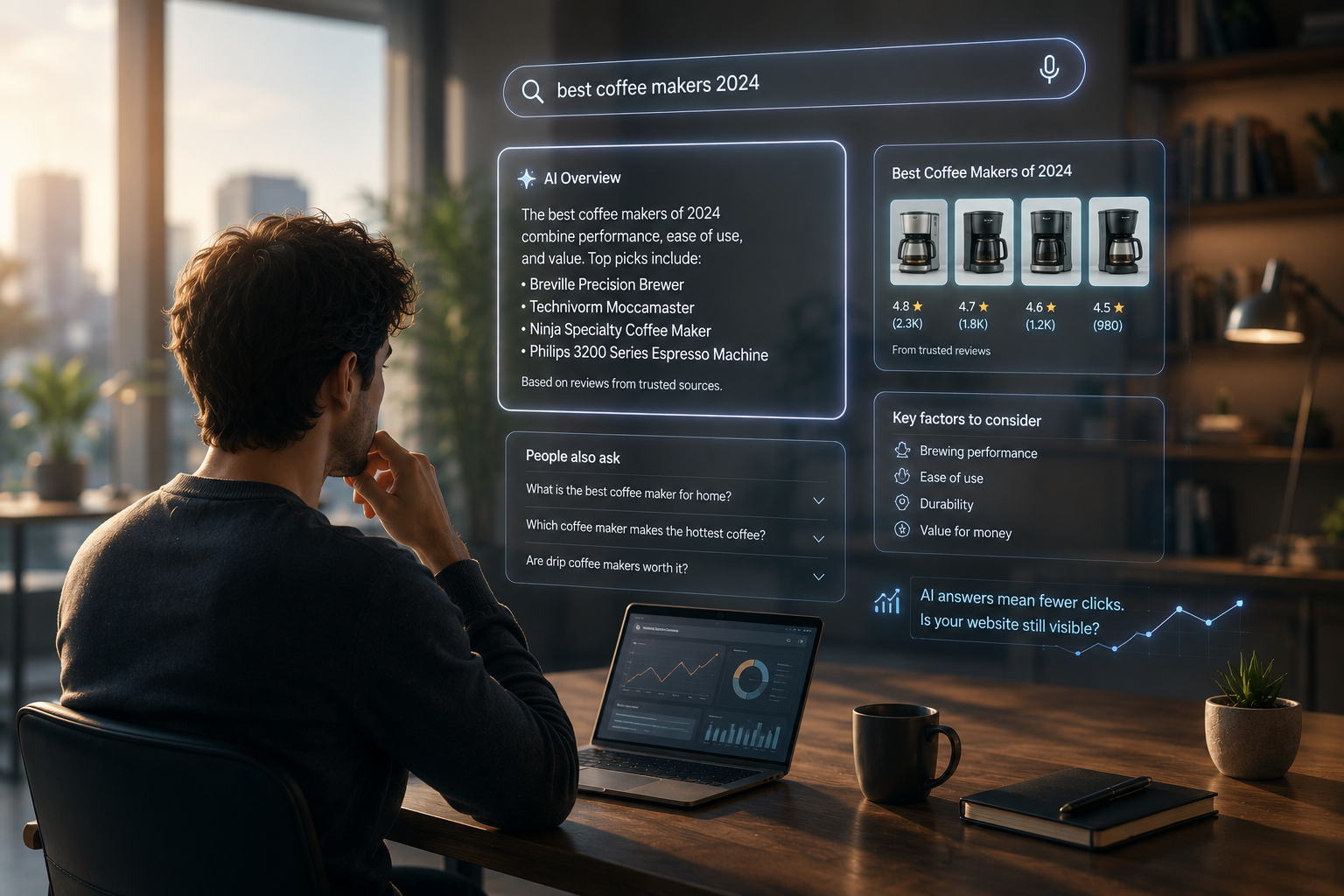
Search is becoming more answer-based. Users can now get information directly inside Google results, AI Overviews, ChatGPT Search, Perplexity, Gemini, Copilot, and other AI-powered tools. In many cases, they do not need to click through to a website to get a basic answer.
This is where zero-click search becomes important.
A zero-click search happens when someone searches for something, gets the information they need directly in the results, and does not click on any website.
This is not entirely new. Google has shown quick answers, maps, featured snippets, calculators, weather boxes, knowledge panels, and People Also Ask sections for years. What is new is the scale and depth of AI-generated answers.
AI can now summarise, compare, explain, and combine information from several sources in a way that feels much closer to a complete answer.
For website owners, this creates a serious question: if people get answers without clicking, what happens to website traffic?
What Is Zero-Click Search?
Zero-click search means the user’s question is answered without a traditional website visit.
For example, someone may search for:
- “weather in Athens tomorrow”
- “time in London”
- “how many grams in a cup”
- “population of Greece”
- “what is local SEO”
- “SEO vs Google Ads”
- “what should a business website include”
For simple factual searches, zero-click results have been common for a long time. A user asks something quick, gets the answer, and leaves.
AI makes this more important because it can now handle more complex questions.
Instead of only answering “what is local SEO,” an AI result may explain why it matters, how Google Business Profile fits in, why reviews are important, and what a small business should do first.
That means content that once brought a click may now be summarised before the user reaches the website.
This does not mean websites are no longer useful. It means the role of websites is changing.
Why AI Makes Zero-Click Search More Important
AI search tools are designed to reduce friction.
They help users get a faster first answer. Instead of opening several tabs, scanning multiple pages, and comparing sources manually, the user can ask one question and receive a structured response.
For the user, this is convenient.
For websites, it is more complicated.
A website may contribute information to the answer, directly or indirectly, but receive fewer visits. The user may learn from the content without clicking through to the original page.
That is the main tension.
Websites still provide the information that search systems rely on, but some of the attention stays inside the search platform or AI tool.
This is especially challenging for publishers, blogs, informational websites, and businesses that rely heavily on educational content to attract visitors.
The old assumption was simple: visibility leads to clicks.
Now, visibility may also mean being mentioned, cited, summarised, or influencing the answer without always receiving the same amount of traffic.
Does This Mean SEO Is Dead?
No. SEO is not dead.
But lazy SEO is becoming less useful.
People still search. They still compare businesses, read reviews, check services, look at portfolios, explore prices, research options, and visit websites before making important decisions.
What is changing is that basic information may no longer be enough to earn a click.
If your content only gives a simple definition, an AI summary may satisfy the user before they reach your page. But if your content offers depth, examples, experience, case studies, clear service information, strong opinions, or practical decision-making support, there is still a reason to visit.
For example, AI can explain what a Google Business Profile is. But if someone is deciding whether to work with your marketing agency, they will still want to see your approach, examples, services, reviews, and credibility.
AI can summarise the difference between a landing page and a website. But a business owner may still need a specialist to review their own website, build a landing page, or create a strategy.
So the goal of SEO is shifting.
It is not only about attracting clicks from every possible search. It is about becoming a trusted source and appearing in the moments that influence real decisions.
Which Websites Are Most at Risk?
Websites that depend mainly on simple informational content are more exposed.
If a site mostly answers basic questions such as “what is,” “when did,” “how many,” or “definition of,” it may lose more traffic as AI and rich search results become better at answering those questions directly.
That does not mean informational content has no value. It means it needs to become stronger.
A basic article titled “What is SEO?” is easy to summarise. An article titled “How Can a Small Business Decide Whether to Invest in SEO or Google Ads First?” is harder to replace because it deals with context, priorities, trade-offs, and real decision-making.
The more generic the content, the easier it is for AI to replace the click.
The more specific, useful, practical, and experience-based the content, the more reasons a user has to continue to the website.
This is an important distinction.
The problem is not that AI can answer questions. The problem is when a website does not offer anything beyond the first answer.
What Does This Mean for Small Businesses?
For small businesses, zero-click search is not a reason to panic.
It is a reason to improve the website.
A local business, professional service, clinic, hotel, e-commerce brand, consultant, or agency should not rely only on generic blog posts. The website needs to become a place of trust, proof, and decision-making.
That means having clear service pages, real examples, customer reviews, strong calls to action, local information, useful FAQs, case studies where possible, and content that answers the questions people ask before they buy.
AI may be able to explain the concept behind your service. But it cannot fully replace the trust-building role of your website.
It cannot show your real team, your process, your client results, your tone, your local presence, your values, or the specific way you solve problems.
That is where websites still matter deeply.
A website should not only answer “what is this?” It should answer “why should someone choose you?”
From Traffic to Visibility, Trust, and Conversions
In the zero-click era, businesses need to measure success more carefully.
Organic traffic still matters. But it is not the only signal.
You may also need to look at:
- impressions in Google Search Console
- branded searches
- clicks from high-intent keywords
- direct traffic
- enquiries and form submissions
- phone calls
- bookings
- sales
- local map actions
- conversion rate
- mentions or citations in AI search results where visible
A page may receive fewer clicks than before but still support brand awareness. Someone may see your business name in search, read a summary, and search for you later. Another person may visit your site only when they are closer to making a decision.
This makes measurement more complex.
It also makes quality more important.
Traffic for its own sake is not the final goal. A thousand visitors who never take action may be less valuable than fifty highly relevant visitors who are seriously considering your service.
How Should Website Content Change?
The biggest shift is that content must move beyond generic explanations.
Instead of writing only broad articles, businesses should create content that helps people make better decisions.
For example, instead of only writing “What is local SEO?” a business could write:
- “How Local SEO Helps a Small Business Get More Calls”
- “Google Business Profile Mistakes That Cost Local Businesses Customers”
- “SEO or Google Ads: What Should a Small Business Choose First?”
- “What Should a Professional Website Include Before You Run Ads?”
- “Why Your Website Gets Traffic but No Enquiries”
These topics are more practical. They speak to real business problems, not just definitions.
The content should also include examples, context, comparisons, and clear next steps. A reader should feel that the article understands their situation.
That is what makes content harder to replace.
AI can summarise common knowledge. It is less effective at replacing lived experience, specific expertise, local context, and a clear point of view.
Experience and Point of View Matter More
As AI-generated answers become more common, human experience becomes more valuable.
A generic article can say that reviews build trust. A better article explains why people trust customer reviews more than advertising, how they read negative reviews, why overly perfect ratings can create suspicion, and what a business should do in practice.
A generic article can define toxic work culture. A better one explains what leadership should notice, how silence appears in teams, why burnout is often disguised as commitment, and what happens when bad behaviour is excused because someone is a high performer.
The difference is insight.
Websites that continue to matter will not only publish information. They will publish understanding.
Understanding of the customer.
Understanding of the problem.
Understanding of the industry.
Understanding of the decision people are trying to make.
This is where a strong website can still stand out.
The Website Becomes a Trust Hub
In the past, many businesses treated their blog mainly as a traffic tool.
They published articles to target keywords, attract visitors, and increase organic sessions. That can still work, but it is no longer enough on its own.
A modern website needs to become a trust hub.
It should show who you are, what you know, how you think, what you offer, who you help, what proof you have, and why someone should take the next step.
The blog still matters, but it should support the wider business strategy. It should connect to service pages, answer customer questions, build authority, and help visitors move closer to a decision.
A good article is not just an SEO asset anymore.
It is also a brand asset, a sales support tool, and a proof of expertise.
What Should You Avoid?
The worst response to AI and zero-click search is publishing more weak content.
If the strategy becomes “let’s use AI to publish one hundred articles a month,” the website may end up with more pages but less value.
Generic, repetitive, low-quality content is exactly the kind of content that becomes easier to ignore when AI can already answer basic questions.
Businesses should also avoid writing only for machines.
Trying to “game” AI search by adding awkward phrases, robotic FAQs, or over-optimised sections can make content worse for real people. And real people are still the ones who become customers.
The goal is not to trick AI into noticing you.
The goal is to create content that is useful enough to be noticed, trusted, and remembered.
Final Thoughts
AI and zero-click search do not mean websites are finished.
They mean websites need to work harder to justify the click.
Basic information will increasingly be answered directly in search results or AI tools. That means websites must offer something more valuable: trust, experience, clarity, examples, services, proof, and a point of view.
SEO is not disappearing. It is becoming more demanding.
And websites are not losing their purpose. They are becoming less like simple content libraries and more like places where trust is built.
The businesses that adapt will not be the ones publishing the most content.
They will be the ones creating the clearest, most useful, most credible content for the people who are actually trying to make a decision.