Some images seem to affect us before we can explain why.
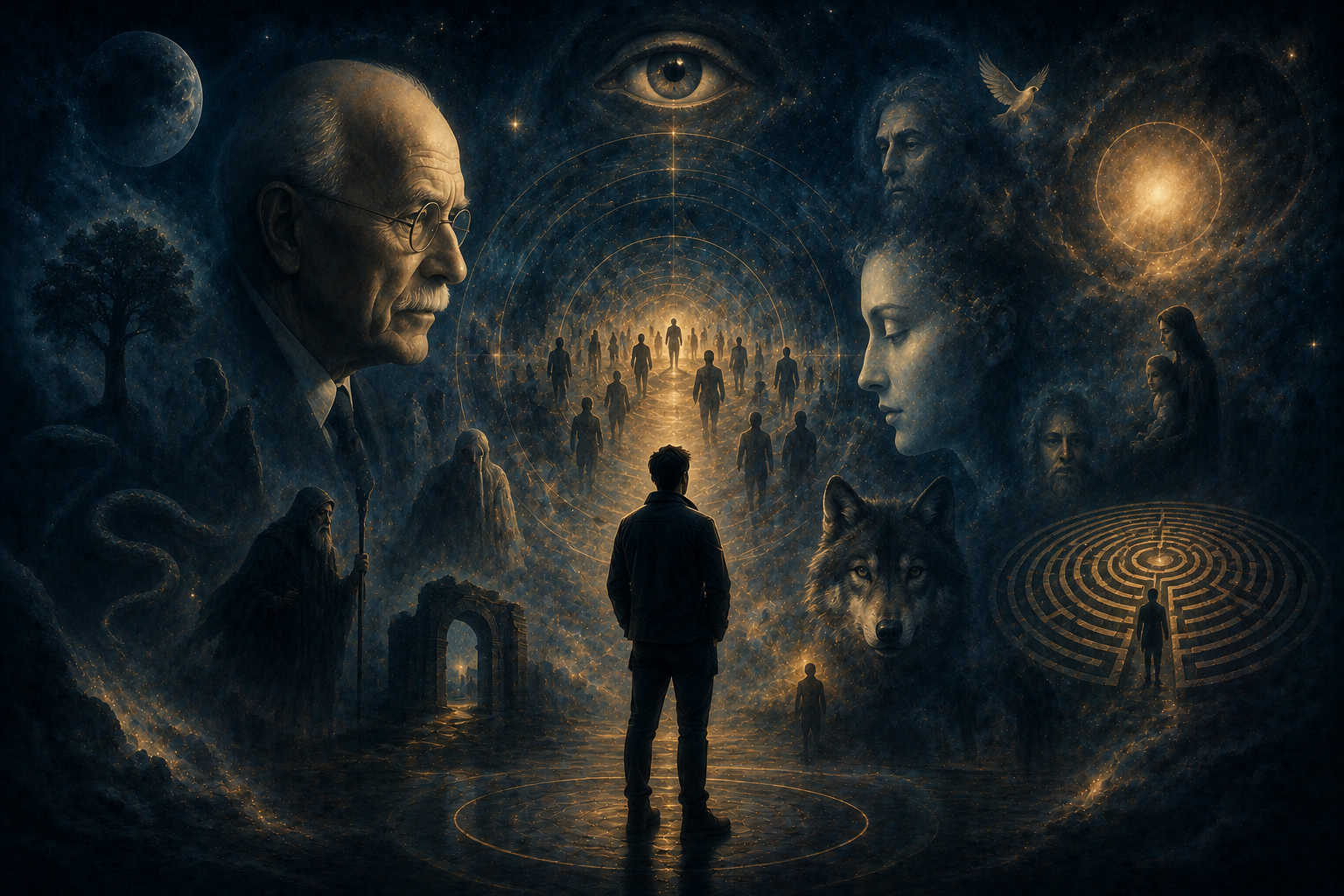
A dark forest. A wise old man. A mother figure. A shadow following us in a dream. A hero who enters danger, faces something terrifying, and returns changed. A snake. A house with hidden rooms. A journey into darkness before some kind of rebirth.
These images appear again and again in myths, dreams, religions, fairy tales, films, and stories from very different cultures. For Carl Jung, this was not just coincidence.
He believed that the human mind is not shaped only by personal memories, childhood experiences, and individual history. Beneath the personal unconscious, he argued, there is a deeper layer of the psyche that is shared by all human beings.
He called this the collective unconscious.
It is one of Jung’s most famous ideas, but also one of the most misunderstood. Some people find it deeply insightful. Others are more sceptical, especially because it is difficult to measure or prove in the way modern psychology usually demands.
Still, the idea remains powerful because it tries to explain something many of us intuitively recognise: certain symbols and stories seem to speak to human beings across time, culture, and language.
Who Was Carl Jung?
Carl Jung was a Swiss psychiatrist and one of the most influential thinkers in the history of psychology.
Early in his career, he worked closely with Sigmund Freud, but their ideas eventually moved in very different directions. Freud focused mainly on the personal unconscious: repressed desires, conflicts, memories, and experiences that the individual may not be fully aware of.
Jung accepted that the personal unconscious mattered. But he believed it was not the whole story.
For Jung, the psyche was much larger than personal memory. He thought that human beings are born with deep psychological patterns that shape the way we imagine, dream, fear, love, create meaning, and understand the world.
In simple terms, he believed that there are parts of the mind that are personal, and parts that are deeply human.
The collective unconscious belongs to that deeper level.
What Is the Collective Unconscious?
The collective unconscious, according to Jung, is a layer of the unconscious mind that is not created by personal experience.
It is not made up of specific memories. It does not contain the exact stories of our childhood, our family, or our individual traumas.
Instead, it contains inherited psychological patterns — not ready-made images, but basic forms that shape the way humans experience certain universal themes.
These themes include birth, death, danger, transformation, motherhood, power, fear, love, the unknown, the self, and the search for meaning.
Jung believed that this is why similar symbols and story structures appear in very different cultures. The hero, the mother, the trickster, the shadow, the wise guide, the journey into the underworld — these are not only cultural inventions. They may also reflect deep structures of the human psyche.
The collective unconscious does not usually appear as a clear thought. It expresses itself through dreams, symbols, myths, fantasies, religious images, art, and powerful emotional experiences.
That is why Jung’s ideas have influenced not only psychotherapy, but also literature, cinema, mythology, spirituality, and the way people think about storytelling.
What Are Archetypes?
The most important concept connected to the collective unconscious is the idea of archetypes.
Archetypes are basic psychological patterns or forms. They are not fixed characters or simple stereotypes. They are more like deep templates through which the mind gives shape to human experience.
Some of Jung’s best-known archetypes include:
The Mother.
The Father.
The Hero.
The Shadow.
The Wise Old Man.
The Child.
The Anima and Animus.
The Self.
For example, the Hero appears in stories where someone leaves the familiar world, faces danger, struggles with fear or temptation, and returns transformed. We see this pattern in ancient myths, religious narratives, fairy tales, novels, and modern films.
The details change from culture to culture, but the emotional structure often feels familiar.
The Shadow is another central Jungian archetype. It represents the parts of ourselves that we do not want to recognise. These are not only “bad” qualities. They can also be rejected desires, hidden strengths, anger, vulnerability, ambition, or anything we have pushed out of our conscious identity.
In dreams and stories, the Shadow may appear as an enemy, a monster, a dark figure, or something threatening. Psychologically, it asks us to look at what we have refused to see in ourselves.
This is why Jung’s work can feel so personal. His ideas are not only about ancient symbols. They are also about the parts of ourselves we avoid.
Why Jung Took Dreams So Seriously
For Jung, dreams were not random nonsense.
He saw them as a language of the unconscious.
He believed that dreams often try to communicate something important to the conscious mind, not through direct explanations, but through images and symbols.
A dream about being lost in an unfamiliar house, for example, might not be about a literal house. From a Jungian perspective, it could suggest unexplored parts of the self.
A dream about dark water might be connected with deep emotion or unconscious material.
A dream about being chased by a frightening figure might point to something the dreamer is avoiding internally.
But Jung did not believe in simple dream dictionaries.
He would not say, “If you dream of a snake, it always means this.” The meaning of a symbol depends on the person, their life, their emotional reaction, their culture, and the wider context of the dream.
This is an important difference.
Jungian dream interpretation is not about giving every image one fixed meaning. It is about exploring how the symbol lives inside that particular person’s inner world.
The Collective Unconscious and Myth
Jung was fascinated by myths because he believed they reveal deep patterns of the human psyche.
For him, myths were not just old stories people used to tell before modern science. They were symbolic expressions of inner human realities.
Through gods, monsters, heroes, journeys, deaths, transformations, and rebirths, cultures gave shape to psychological experiences that are difficult to describe directly.
Why do we fear the unknown?
Why does growth often require loss?
Why do people need stories of descent before renewal?
Why do we keep returning to images of darkness, transformation, sacrifice, and rebirth?
These themes appear again and again across human history.
From ancient mythology to modern cinema, we keep telling stories about people who must face what they fear, leave behind an old identity, and return changed.
Jung would argue that these stories stay with us because they do not only entertain us. They speak symbolically to something deep inside us.
That may be why certain films, novels, and myths feel strangely familiar even when they come from another time or culture.
They touch something older than personal experience.
The Process of Individuation
Another key idea in Jung’s psychology is individuation.
Individuation is the process of becoming more fully yourself.
This does not mean becoming selfish or separate from other people. It means becoming more whole. For Jung, a person is not fully mature when they simply perform the role society gives them. They become more complete when they begin to recognise the unconscious parts of themselves as well.
This includes the Shadow, hidden fears, undeveloped talents, contradictions, desires, and emotional truths that may have been ignored for years.
Individuation is not always comfortable.
It often means facing things we would rather avoid. It means admitting that we are more complex than the image we present to the world. It means accepting that there are parts of us that do not fit neatly into who we thought we were.
The collective unconscious matters here because archetypes often appear when a person is going through deep psychological change.
A dream, a repeated symbol, a powerful story, or a strong emotional reaction may point toward something the person needs to confront or integrate.
In that sense, Jung did not see psychological growth as simply becoming happier or more functional.
He saw it as becoming more whole.
Is the Collective Unconscious Scientifically Proven?
This is where we need to be careful.
The collective unconscious is an influential theoretical concept, but it is not scientifically proven in the same way that many modern psychological theories are tested today.
It is difficult to measure directly. It does not fit easily into standard experimental methods. Many psychologists are cautious about treating it as a literal biological structure.
That does not mean the idea has no value.
It means we should understand it as a symbolic, theoretical, and clinical framework rather than a fully established scientific fact.
Its value lies in the questions it opens.
Why do similar myths appear in different cultures?
Why do some symbols carry such strong emotional force?
Why do people use stories and images to make sense of suffering, change, love, death, and identity?
Why do dreams sometimes feel as though they are showing us something we did not consciously know?
Modern psychology may not accept all of Jung’s claims in a literal way, but his influence remains strong in psychotherapy, literature, film studies, mythology, religious studies, and the wider conversation about meaning.
Why Jung Still Feels Relevant Today
We live in a time that often tries to explain human beings through data, behaviour, productivity, and visible outcomes.
Jung reminds us that people are also symbolic creatures.
We do not only live through facts. We live through stories.
We create narratives about who we are, what we have survived, what we fear, what we are becoming, and what our pain means.
Even today, people are drawn to archetypal stories: the outsider who discovers their strength, the wounded person who transforms, the hero who fails and rises again, the shadow self that must be faced, the journey into darkness before a new life begins.
These are not just entertainment patterns. They reflect emotional truths people still recognise.
That is why Jung continues to interest so many readers. He did not treat the human mind as a machine that simply reacts to events. He saw it as a deep inner world filled with symbols, conflicts, hidden meanings, and possibilities for transformation.
You do not have to agree with every part of his theory to appreciate that insight.
Final Thoughts
The collective unconscious is one of Carl Jung’s most fascinating ideas.
It suggests that beneath our personal memories and experiences, there may be a deeper layer of the psyche that connects us to universal human patterns. These patterns appear through archetypes, dreams, myths, symbols, and stories that return again and again across cultures.
We should not treat the collective unconscious as a simple scientific fact. It is better understood as a powerful psychological and symbolic framework.
But even with that caution, the idea remains meaningful.
It helps us think about why certain stories move us. Why some dreams stay with us. Why symbols can feel powerful before we understand them. And why becoming ourselves may require facing parts of the mind that are older, deeper, and less rational than everyday thought.
Perhaps Jung’s lasting message is this:
Inside each of us there is not only a personal history.
There is also a deeper human story.