Many business owners hear the terms “website” and “landing page” all the time, especially when discussing digital marketing, Google Ads, social media campaigns, or lead generation.
Still, the difference between the two is often misunderstood.
Some people assume that a landing page is simply a smaller website. Others believe that a standard business website can handle every marketing need on its own. In reality, they serve different purposes.
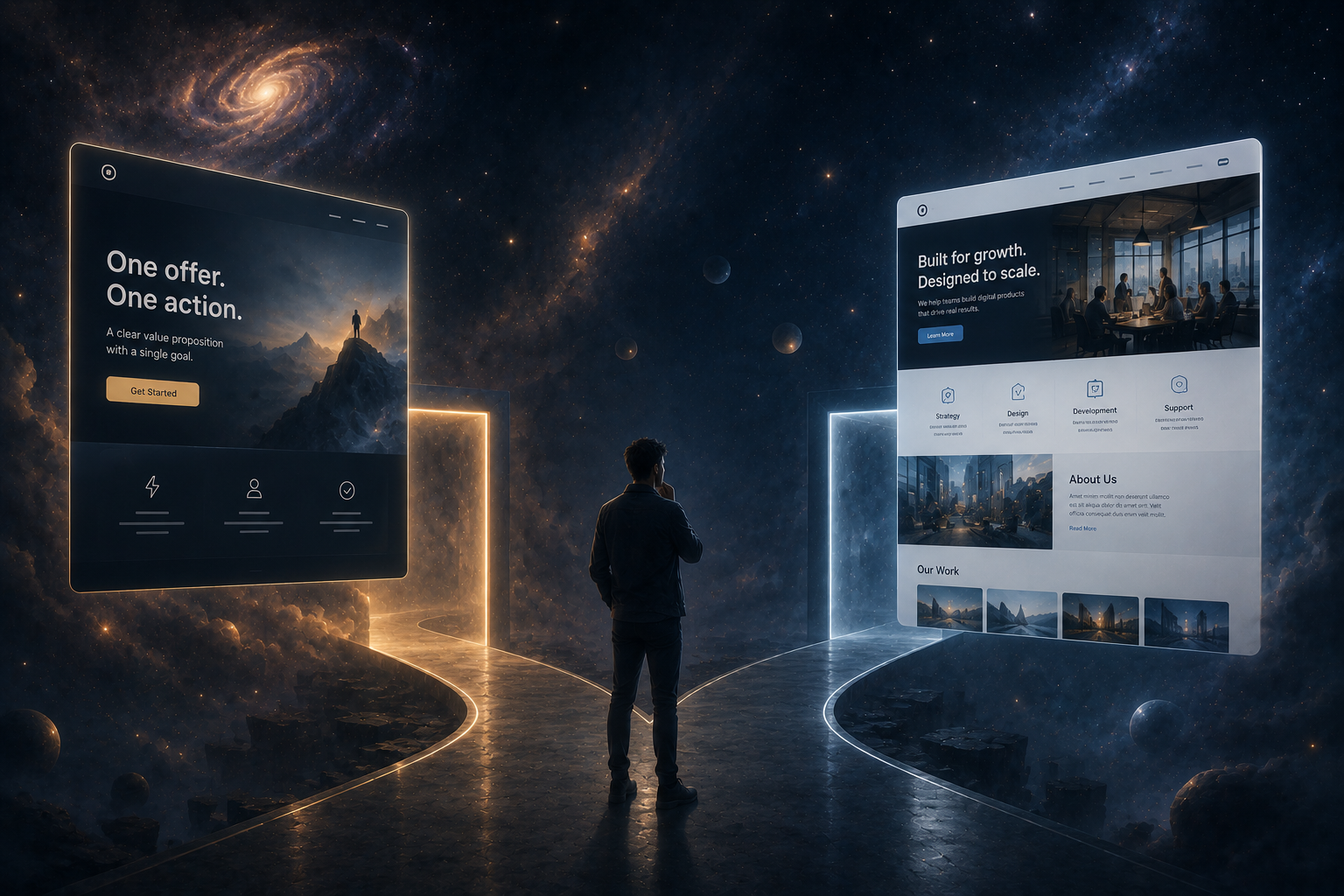
A website is designed to give people a complete picture of your business. It helps visitors understand who you are, what you offer, why they should trust you, and how they can contact you.
A landing page is much more focused. It is built around one offer, one audience, and one specific action.
That action could be booking a consultation, requesting a quote, downloading a guide, signing up for an event, purchasing a product, registering for a webinar, or claiming a limited-time offer.
The question is not whether a landing page is better than a website.
The real question is: what do you need your visitor to do?
What Is a Business Website?
A business website is your main online home.
It usually includes several pages and gives visitors the freedom to explore your business at their own pace. Someone may visit your homepage, browse your services, read about your team, check your portfolio, look at testimonials, read articles, compare products, or contact you when they feel ready.
A typical business website may include pages such as:
- Home
- About Us
- Services
- Products
- Portfolio or Case Studies
- Blog
- FAQs
- Contact
Think of it as the digital version of your business headquarters.
It gives people the wider context they need before making a decision. This is particularly important for services where trust matters, where the customer journey is longer, or where people need more information before they commit.
A psychologist, hotel, law firm, dental clinic, construction company, marketing agency, consultant, or real estate business usually benefits from having a complete website. Visitors want to know more than just the price or offer. They want to understand the people behind the business, the experience, the approach, the work quality, and the reasons they should choose one provider over another.
A website builds credibility over time.
What Is a Landing Page?
A landing page is a standalone page created for a specific goal.
It is not meant to explain everything about your business. It does not need to show every service, every product, or your full company story.
Instead, it focuses the visitor’s attention on one clear message and one next step.
For example, you may create a landing page for:
- a special offer on a service
- a free consultation
- a seasonal hotel package
- a product launch
- a webinar or workshop
- an event registration
- a downloadable guide
- a limited campaign
- a Google Ads campaign
- a Meta Ads campaign
A landing page normally includes fewer navigation options than a full website. This is intentional.
The goal is to reduce distractions and make it easier for the visitor to decide whether they want to take action.
If someone clicks on an ad for a specific service, they should land on a page that speaks directly about that service. They should not have to search through a homepage, open several menus, and try to work out what applies to them.
A good landing page gives them the information they need quickly and makes the next step simple.
The Main Difference: Exploration vs Conversion
The easiest way to explain the difference is this:
A website is built for exploration.
A landing page is built for conversion.
On a website, the visitor can move around freely. They can read articles, compare services, visit your About page, look at your work, and come back another day.
On a landing page, the journey is more direct.
The visitor sees a specific offer, understands the benefit, reads the key details, sees proof that the business is trustworthy, and is encouraged to take one action.
That does not mean a landing page needs to be pushy or overly sales-focused.
It simply needs to be clear.
For example, if your goal is to get more people to book a free strategy call, the page should focus on that call. It should explain who it is for, what they will get from it, why it may be useful, and how to book.
If you are promoting a particular product, the page should help visitors understand what the product does, what problem it solves, why it is worth considering, and how they can buy it.
The more focused the goal, the more useful a landing page becomes.
When Does a Business Need a Landing Page?
A landing page is especially useful when you are running a campaign with a clear offer.
For example, imagine a hotel that wants to promote a September stay package. Sending people from an ad to the general homepage may not be enough. Visitors may need to search for the offer, compare dates, and work out whether it applies to them.
A dedicated landing page can present the package clearly. It can include the travel dates, room options, booking benefits, photos, guest reviews, and a visible booking button.
The same applies to professional services.
A marketing agency offering a free website audit could create a landing page that explains what the audit includes, who it is for, what common issues it can uncover, and how someone can request one.
A training company promoting a seminar can create a page with the event topic, speaker details, schedule, ticket price, registration form, and practical information.
A landing page works best when there is one message, one target audience, and one action you want people to take.
When Should You Build a Full Website First?
If your business does not yet have a strong and reliable online presence, a professional website should usually come first.
A landing page can generate leads for a campaign, but it cannot fully replace the trust-building role of a proper website.
People often do more research before they contact a business.
They may see your ad, become interested, and then search for your company name. They may want to see who you are, look at your services, read reviews, check your location, browse previous work, or understand whether you are a genuine and established business.
If they find only one campaign page with limited information, some may hesitate.
That is why a website is the foundation.
It does not need to be huge from day one. A smaller website with a strong homepage, clear service pages, an About section, contact details, and a few trust signals can be enough to start. What matters is that it feels professional, clear, and credible.
Landing pages can then be added later to support specific campaigns, services, offers, or advertising activity.
What Should a High-Converting Landing Page Include?
A good landing page does not need to be long for the sake of being long. It needs to answer the right questions in the right order.
The first section should make the offer clear immediately. The visitor should understand what the page is about within a few seconds.
Then, the page should explain why the offer matters.
What problem does it solve? Who is it designed for? What makes it useful? What happens after someone fills in the form or clicks the button?
Trust is also important.
A landing page may include customer reviews, testimonials, case studies, statistics, partner logos, before-and-after examples, qualifications, or images of the real team behind the business.
Finally, the call to action should be simple and specific.
“Request your free consultation,” “Check availability,” “Get your quote,” “Book your place,” or “Download the guide” is much clearer than a vague button that says “Submit.”
The visitor should always know what will happen next.
Can a Landing Page Help with SEO?
It can, but that is not always its main purpose.
Most landing pages are created for paid advertising, email campaigns, social media promotions, or short-term offers. In these cases, the main goal is usually conversion rather than organic visibility.
However, a landing page can also perform well in search results when it is built around a valuable service, a local search term, or a clear customer need.
For that to happen, the page needs more than a headline and a form. It should include useful information, relevant keywords used naturally, well-structured headings, strong internal links, and content that genuinely helps the visitor understand the service.
For example, a local clinic could have a landing page for a specific treatment in a specific area. A hotel could have a page for a seasonal offer that also answers practical questions about the destination. A digital agency could build a detailed page around website design services for small businesses.
The important thing is to decide from the beginning what the page is for.
Is it created to rank in Google? To support ads? To collect leads from Instagram? To promote an event? The strategy should reflect that purpose.
A Website and a Landing Page Work Better Together
A website and a landing page are not competing options.
They are different tools that work well together.
Your website gives people the bigger picture. It shows your business identity, services, expertise, work, team, and credibility. It can attract people through Google searches, build long-term trust, and support your overall online presence.
Your landing pages help you focus attention when you have a specific campaign or commercial goal.
They are useful when you want to promote one offer, one service, one product, one event, or one clear action.
For example, your website may explain everything your business does. But when you run an ad campaign for a free consultation or a seasonal hotel offer, a dedicated landing page can make the path to conversion much easier.
The website builds the relationship.
The landing page helps move that relationship forward.
Final Thoughts
A standard website and a landing page have different jobs.
A website is your long-term digital presence. It helps customers understand your business, trust your expertise, explore your services, and find you through search engines.
A landing page is a focused marketing tool. It is designed to support a particular campaign and encourage a specific action.
For most businesses, the strongest approach is not choosing one over the other.
It is having a clear, professional website as the foundation, then using landing pages when you want to promote a specific service, offer, campaign, or message with more precision.
When each tool is used for the right purpose, your digital marketing becomes clearer, more effective, and much easier for potential customers to act on.