A child is not simply a small adult with less information.
A child thinks differently.
They do not just know fewer facts than adults. They understand the world through a different mental framework — one that changes as they grow, explore, make mistakes, ask questions, and try to make sense of what is happening around them.
This was one of Jean Piaget’s most important ideas.
Piaget was not only interested in what children know at different ages. He wanted to understand how they think. How they understand objects, time, space, rules, numbers, other people, cause and effect, and themselves.
His theory of cognitive development became one of the most influential theories in developmental psychology. Although it has been criticised and revised over time, it remains important because it helped change the way we see children’s thinking.
The child is not an empty container waiting to be filled with information.
The child is an active explorer, trying to build an understanding of the world.
Who Was Jean Piaget?
Jean Piaget was a Swiss psychologist best known for his work on children’s cognitive development.
He originally had a strong interest in biology, and that background influenced the way he thought about development. He saw children as active organisms adapting to their environment, not as passive receivers of knowledge.
One of the most interesting parts of his work was the way he treated children’s mistakes.
For many adults, a wrong answer simply means the child does not know. Piaget looked at it differently. He believed that children’s mistakes could reveal the way they were thinking.
Instead of asking only, “Is the answer correct?”
He asked, “What kind of thinking led the child to this answer?”
That question changed a lot.
It encouraged psychologists, teachers, and parents to take children’s thinking seriously, even when it appears illogical from an adult point of view.
The Main Idea: Children Build Knowledge
At the centre of Piaget’s theory is the idea that children actively construct knowledge.
They do not learn only because adults explain things to them. They learn by touching, observing, comparing, experimenting, asking questions, and testing what happens.
A young child does not first understand the world through abstract ideas. They understand it through action.
They hold objects, drop them, shake them, hide them, search for them, put them in their mouth, and repeat actions to see what changes.
To an adult, this may look like simple play.
For the child, it is a way of learning.
Piaget often described children as little scientists. They form ideas about the world, test them through experience, and slowly adjust their understanding.
Schemas, Assimilation, and Accommodation
Piaget used the word schemas to describe the mental structures we use to organise experience.
A schema is like a framework for understanding something.
A baby may have a schema for grasping an object. An older child may have a schema for “dog,” “toy,” “family,” “school,” or “rules.”
When children meet something new, they often try to fit it into what they already know. Piaget called this assimilation.
For example, a child who knows the word “dog” may see a horse and call it a dog because it has four legs and looks like an animal they already recognise. The child is trying to understand something new through an existing category.
But sometimes the new experience does not fit.
Then the child has to change their existing schema or create a new one. Piaget called this accommodation.
In the same example, when an adult explains that the animal is not a dog but a horse, the child begins to adjust their understanding. They learn that not every four-legged animal belongs in the same category.
Cognitive development, for Piaget, happens through this ongoing process.
Sometimes we fit new experiences into what we already know.
Sometimes we have to change what we know so that new experiences can make sense.
The Four Stages of Cognitive Development
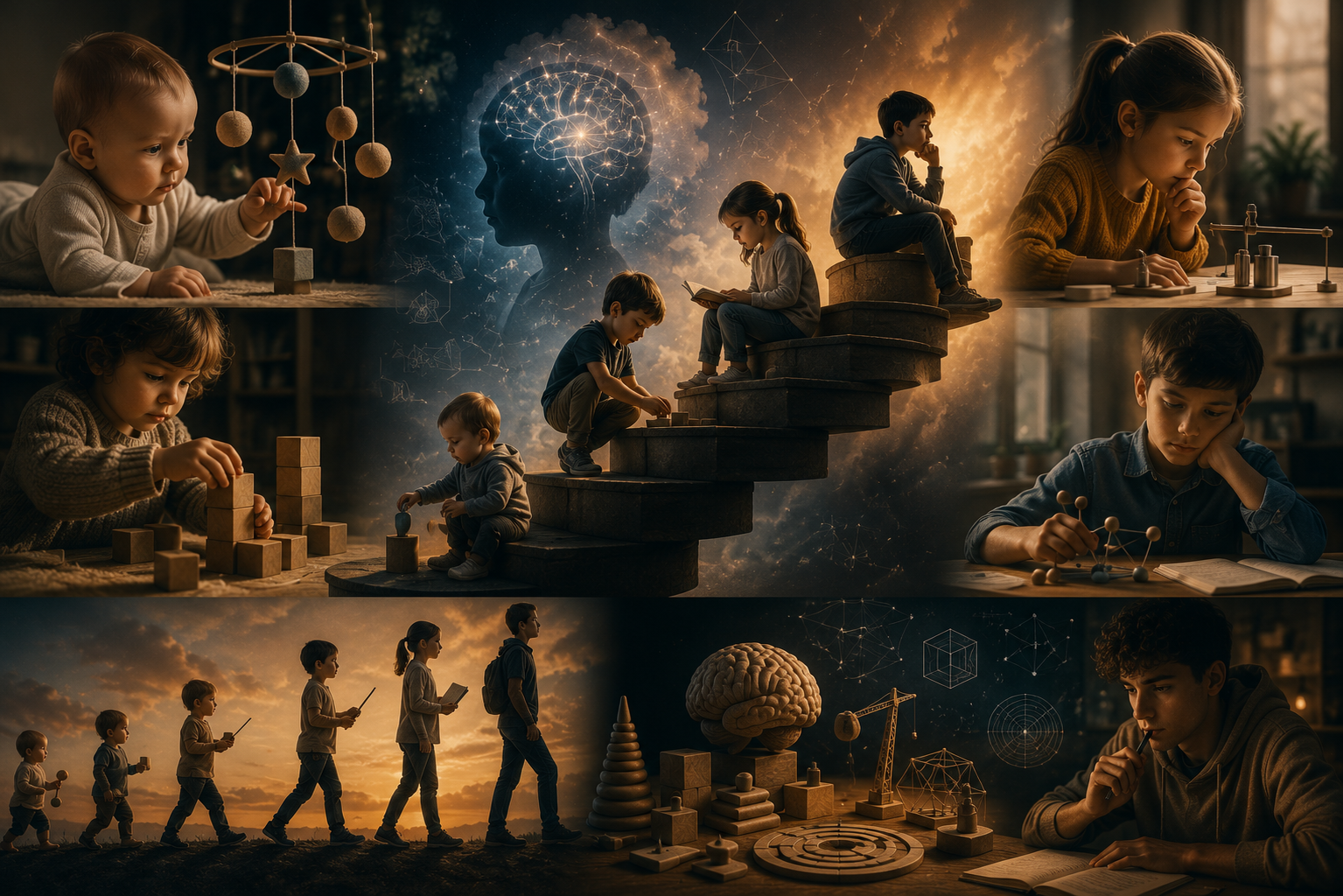
Piaget proposed that cognitive development moves through four main stages.
Each stage represents a different way of thinking.
The ages linked to each stage are approximate. Children do not all develop at exactly the same speed, and modern psychology does not treat the stages as rigid boundaries.
Still, the stages remain useful because they show how children’s thinking can change qualitatively over time.
1. The Sensorimotor Stage
The sensorimotor stage lasts from birth to around two years of age.
During this period, infants learn mainly through their senses and movements. They look, touch, listen, reach, grasp, suck, crawl, shake objects, and repeat actions.
Their knowledge is practical and physical. They are not yet thinking in words or abstract concepts. They are learning through direct experience.
One of the most important developments during this stage is object permanence.
Object permanence means understanding that an object continues to exist even when it cannot be seen.
For adults, this is obvious. If a toy is hidden under a blanket, we know it has not disappeared. But for a very young infant, this is not always clear.
Over time, the child begins to understand that the world continues to exist even when it is out of sight.
This is a major step because it shows that the child is beginning to form mental representations of things.
2. The Preoperational Stage
The preoperational stage usually takes place from around two to seven years of age.
This is the period when language develops rapidly and children begin to use symbols.
A cardboard box can become a car. A stick can become a sword. A blanket can become a castle. Pretend play becomes important because it shows that the child can use one thing to represent another.
However, children’s thinking at this stage is still limited in certain ways.
One important feature is egocentrism. This does not mean the child is selfish in the everyday sense. It means the child may struggle to see things from another person’s perspective.
They may assume that other people see what they see, know what they know, or feel what they feel.
Children at this stage may also struggle with conservation.
For example, imagine pouring the same amount of water into two identical glasses. Then the water from one glass is poured into a taller, narrower glass. A young child may say the taller glass has more water, simply because the water level looks higher.
The child is focusing on one obvious feature and has difficulty considering several aspects of the situation at the same time.
3. The Concrete Operational Stage
The concrete operational stage usually develops between the ages of around seven and eleven.
At this stage, children begin to think more logically, especially about concrete situations.
They can understand conservation more reliably. They can see that the amount of water stays the same even when the shape of the glass changes. They can classify objects, arrange things in order, understand relationships, and follow logical rules more consistently.
Their thinking becomes more organised.
However, it is still strongly connected to real objects and actual experiences.
Children at this stage usually handle practical, visible, and concrete problems better than purely abstract ones.
For example, they may solve a maths problem more easily when it involves real objects or familiar situations. But a completely abstract logical problem may still be difficult.
This stage shows that logical thinking is developing, but it is not yet fully abstract.
4. The Formal Operational Stage
The formal operational stage begins around eleven or twelve years of age and continues into adolescence and adulthood.
This is the stage where abstract thinking becomes more developed.
Adolescents become more able to think hypothetically, imagine possibilities, reason about ideas they have not directly experienced, and work with more complex concepts.
They can think about justice, freedom, identity, morality, the future, values, and possible consequences.
They can ask not only, “What is happening?”
But also, “What could happen?”
This does not mean that every adolescent or adult always thinks logically or maturely. Abstract thinking does not remove emotion, impulsiveness, or social influence.
But it does mean that the person becomes more capable of thinking beyond the immediate and concrete.
They can reason about possibilities, not only realities.
Why Piaget’s Theory Was So Important
Piaget’s theory was important because it changed the image of the child.
Before his work, children were often seen as less knowledgeable versions of adults. Piaget showed that children’s thinking has its own structure and logic.
A child’s answer may look wrong to an adult, but it may still make sense within the child’s stage of development.
This had a major impact on education.
If a child does not understand a concept, the issue is not always lack of attention or effort. The concept may simply be presented in a way that does not match how the child is currently able to think.
Piaget’s theory encouraged educators to give more importance to active learning, exploration, play, discovery, and hands-on experience.
Children learn better when they are not only told information, but allowed to interact with it.
Applications in Education
In education, Piaget’s theory reminds us that learning should fit the child’s developmental level.
Younger children often learn best through play, movement, concrete examples, and direct experience. Abstract explanations are usually not enough. They need to see, touch, compare, build, and test.
As children grow older, teachers can introduce more complex reasoning, classification, problem-solving, and logical relationships.
In adolescence, students become more ready for abstract discussion, hypothetical thinking, debate, and critical reflection.
This does not mean teachers should simply wait for development to happen on its own. Guidance still matters.
But Piaget’s theory suggests that teaching works best when it respects the way children are able to think at a given stage.
Learning is not passive absorption.
It is active construction.
Applications for Parents
Piaget’s theory is also useful for parents.
Adults often become frustrated because they expect children to think like grown-ups. They may expect a young child to understand time, irony, another person’s perspective, long-term consequences, or an abstract explanation in a way that is not yet fully available developmentally.
A child who struggles to share is not automatically selfish. They may still be developing the ability to understand another person’s point of view.
A child who keeps asking “why?” is not simply being annoying. They are trying to organise the world.
A child who does not respond well to a future consequence may need a more immediate and concrete explanation.
This does not mean children do not need limits.
They do.
But limits work better when they are explained in a way the child can actually understand.
Piaget helps adults replace some frustration with curiosity.
Instead of thinking, “Why is this child being difficult?”
We can ask, “How is this child understanding the situation right now?”
Criticism of Piaget’s Theory
Although Piaget’s theory remains historically important, it is not accepted without criticism today.
One major criticism is that Piaget may have underestimated children’s abilities. Later research suggested that children can sometimes understand more than he believed, especially when tasks are simpler, more familiar, or less confusing.
Another criticism is that the stages may not be as fixed or universal as Piaget suggested.
Development is often more gradual. It can vary across children, cultures, education, and areas of knowledge.
A child may think very logically in one area they know well, but less logically in another. Development does not always work like a staircase where one stage is completely left behind as the next begins.
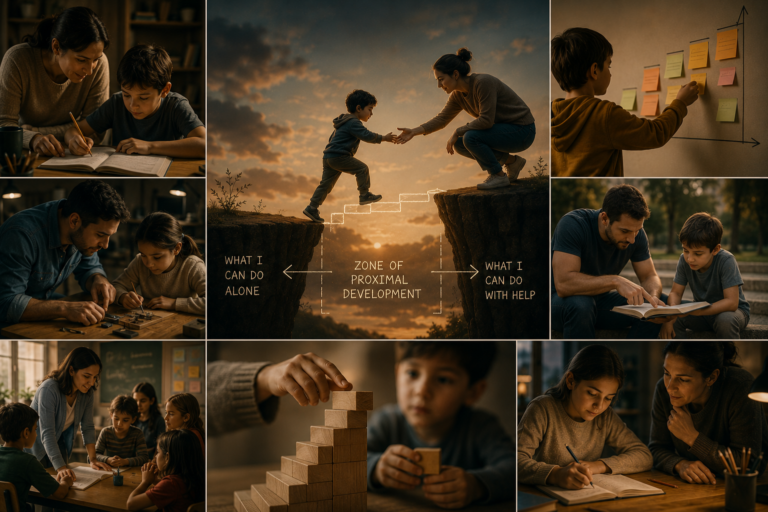
Piaget has also been criticised for placing less emphasis on social interaction than later theorists such as Vygotsky. While Piaget focused strongly on the child’s own exploration, later work showed how much children’s learning is shaped by language, teaching, culture, and support from others.
These criticisms do not make Piaget irrelevant.
They simply put his theory in perspective.
It was a foundation, not the final word.
What Is Still Useful Today?
The most useful message from Piaget is that children’s thinking changes with development.
It does not help to demand adult reasoning from a child who does not yet have the mental tools for it. It also does not help to treat every mistake as laziness, lack of intelligence, or defiance.
Children are trying to understand the world with the tools they currently have.
When we recognise this, we can teach more effectively, communicate more clearly, and set more realistic expectations.
Piaget also reminds us that active learning matters.
Children learn by doing, asking, testing, comparing, failing, and trying again. They are not passive receivers of information. They are active makers of meaning.
That insight remains valuable in classrooms, homes, and anywhere children are learning.
Final Thoughts
Piaget’s theory of cognitive development remains one of the most important theories in developmental psychology.
It showed that children do not simply think less than adults.
They think differently.
Through the stages he described, Piaget tried to explain how children move from sensory and motor experience to symbolic thinking, from concrete logic to more abstract reasoning.
Today, we know that development is more flexible, more gradual, and more influenced by social context than Piaget originally suggested.
Still, his contribution remains enormous.
Perhaps the most important thing he gave us was a different way of seeing the child.
Not as someone who simply does not know yet, but as someone who is already thinking, exploring, organising, and trying to understand the world in their own developmental way.
And when we see children like that, we also change the way we teach them, speak to them, and support them.