
There are things a child can do alone.
There are things a child cannot do yet, no matter how hard they try.
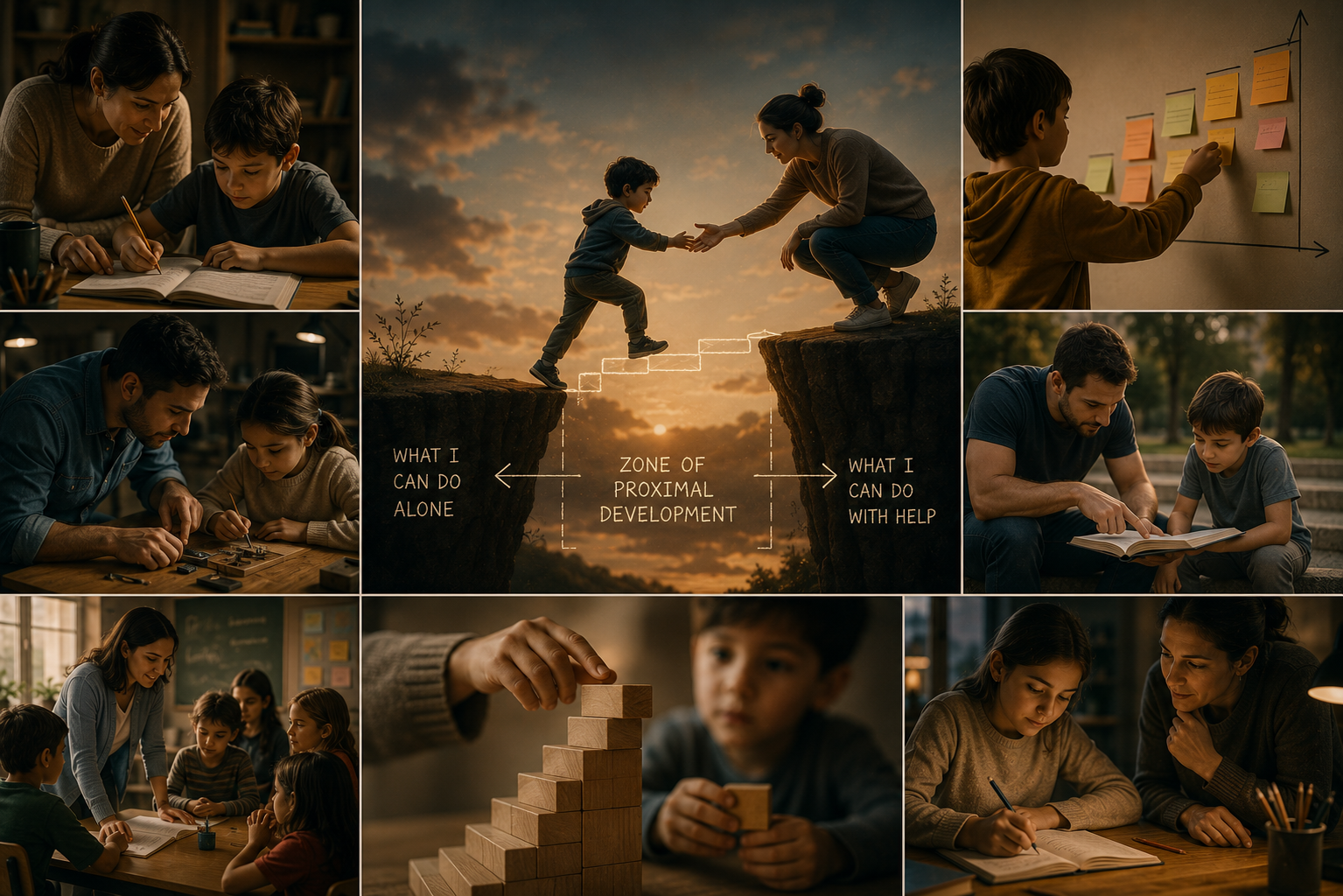
And then there is a third category: things a child cannot quite do independently today, but can manage with the right support from someone more experienced.
This third space is at the heart of one of Lev Vygotsky’s most important ideas: the zone of proximal development.
Vygotsky’s theory changed the way many people think about learning because it placed social interaction at the centre of development. For him, children do not learn as isolated individuals, simply discovering the world on their own. They learn through relationships — with parents, teachers, older siblings, classmates, mentors, and anyone who can help them move one step beyond what they can already do.
In other words, learning is not only personal.
It is social.
And that is the key message in Vygotsky’s work: we should not only ask what a child can do right now. We should also ask what they are ready to do with the right kind of guidance.
Who Was Lev Vygotsky?
Lev Vygotsky was a Russian psychologist who lived in the early twentieth century. Although he died very young, his work became highly influential in developmental psychology and education.
Unlike theories that focused mainly on the child’s individual development, Vygotsky argued that thinking develops within a social and cultural context.
A child’s mind is shaped not only by age or biological growth, but also by language, family, school, culture, tools, values, and the people around them.
This means we should not see the child as a small adult developing in isolation. We should see the child as someone growing through interaction.
For Vygotsky, many skills first appear between people before they become part of the individual child.
A child may first solve a problem with help, discussion, imitation, or guidance. Later, that same skill becomes internal. What was once shared with another person becomes something the child can do alone.
What Is the Zone of Proximal Development?
The zone of proximal development is the distance between what a learner can do independently and what they can do with support.
It is not the area of things they already know. That is too easy.
It is not the area of things that are far beyond their current ability. That is too difficult and often leads to frustration.
It is the middle space.
The place where the learner is challenged, but not lost.
The place where they struggle a little, but can still succeed if someone gives the right help.
For example, a child may not be able to solve a maths problem alone. But if a teacher asks the right question, shows the first step, or helps the child organise their thinking, the child may be able to complete it.
That skill is inside the child’s zone of proximal development.
This idea is important because it changes the way we understand ability.
Instead of asking only, “What can this child do alone?”
We also ask, “What can this child do with guidance?”
That second question tells us something powerful about potential.
Why Learning Should Not Be Too Easy or Too Hard
If we only give children tasks they can already do, they may feel comfortable, but they do not grow very much.
There is no real challenge. They do not need to stretch their thinking. They do not need to develop a new strategy.
But if we give them something far too difficult, the result is often discouragement.
They may start thinking, “I cannot do this,” even when the real problem is not lack of ability, but lack of appropriate support.
The zone of proximal development sits between these two extremes.
It is where the task is difficult enough to require effort, but not so difficult that the learner gives up.
This applies to adults too.
A new employee, a student, an athlete, or someone learning a new language usually grows best when the challenge is just beyond their current level. Not impossibly hard, but not effortless either.
Good learning happens when people are stretched, not crushed.
The Role of the More Knowledgeable Other
In Vygotsky’s theory, the learner is supported by what is often called a more knowledgeable other.
This could be a teacher, parent, mentor, coach, older sibling, skilled peer, or anyone who knows more about the specific task.
The person does not need to be an expert in everything. They simply need to have enough knowledge or experience to guide the learner forward.
Their role is not to give the answer immediately.
Their role is to help the learner reach the answer in a way they can eventually repeat alone.
This might involve asking questions, giving examples, breaking a task into smaller steps, offering encouragement, demonstrating a method, or giving feedback at the right moment.
A good teacher, for example, does not only say, “That is wrong.”
They might ask:
“What did you try first?”
“What do you notice here?”
“Can we break this into smaller parts?”
“What would happen if we looked at it another way?”
This kind of guidance does more than correct an answer. It teaches the learner how to think.
What Is Scaffolding?
The term scaffolding is closely connected to Vygotsky’s ideas, although it was developed later by other researchers.
The image is simple.
When a building is being constructed, scaffolding supports it until it can stand on its own. In learning, scaffolding works in a similar way.
At first, the learner needs more support. As they become more capable, the support is gradually reduced. Eventually, they can complete the task independently.
For example, when a child is learning to write, an adult may first show them how to form letters. Then the child tries with small corrections. Later, the adult steps back as the child becomes more confident.
Good scaffolding is flexible.
Too much help can prevent independence.
Too little help can leave the learner overwhelmed.
The skill is in knowing when to step in and when to step back.
That is what makes teaching, parenting, coaching, and mentoring so delicate. The goal is not to keep the learner dependent. The goal is to support them until they no longer need the same level of support.
Why Language Matters So Much
For Vygotsky, language was central to thinking.
Language is not only a tool for communication. It is also a tool for organising thought.
Children often talk to themselves while playing or solving problems. A child might say, “First I put this here… no, that does not fit… maybe I turn it around.”
This kind of private speech is not meaningless chatter. It is thinking out loud.
Over time, that external speech becomes internal speech. The child no longer needs to say every step out loud because the process has become part of their inner thinking.
This matters in education because when adults explain how they think, not only what the answer is, they give children tools for thinking.
A teacher who says, “Let’s look at the problem step by step,” is not just helping with that one task. They are modelling a way of approaching difficulty.
Eventually, the learner can use that structure independently.
Learning Through Collaboration
Vygotsky believed that learning is deeply social.
Children do not learn only from adults. They can also learn from peers.
When students work together, they may hear different strategies, explain their thinking, ask questions, and notice things they would not have seen alone.
A child who explains something to another child often understands it better themselves. A student who hears a classmate solve a problem differently may discover a new way of thinking.
But collaboration does not mean simply putting children into groups and hoping learning happens.
Good collaborative learning needs structure.
There should be a clear task, a purpose, and an environment where students can ask questions without feeling embarrassed.
Social interaction helps learning when it is meaningful, not when it is just forced.
How Vygotsky’s Theory Applies in Education
Vygotsky’s ideas have had a major impact on teaching.
A teacher influenced by this approach does not focus only on what students already know. They try to identify the next realistic step for each learner.
This can lead to differentiated teaching.
Not every student needs the same kind of support. Some need more examples. Some need more time. Some need a challenge. Some need encouragement. Some need help organising their thoughts.
The theory also changes how we think about assessment.
If we only test what a student can do alone, we may miss an important part of their ability: what they are ready to learn.
A child who needs help today may be able to do the same task independently tomorrow if the support is right.
In this view, mistakes are not simply failures. They are information. They show where guidance is needed.
How It Applies at Home
The zone of proximal development is not only relevant in the classroom.
It appears constantly in family life.
A parent may help a child get dressed, organise a school bag, solve a small problem, manage frustration, or talk through a difficult feeling.
The key is not to do everything for the child.
If a parent always takes over, the child does not get the chance to learn. But if the parent leaves the child completely alone with something they are not ready to manage, the child may feel helpless.
The helpful position is somewhere in between:
“I am here with you, but I will not do all of it for you.”
This applies to emotions too.
A child does not learn self-regulation simply because an adult says, “Calm down.”
They learn when someone first helps them calm down, name what they feel, understand what happened, and slowly develop the ability to do this more independently.
How It Applies to Adults
Although Vygotsky’s theory is mostly discussed in relation to children, the idea applies to adults as well.
A new employee learns best when they are not abandoned to figure everything out alone, but also not controlled so much that they never take ownership.
They need guidance, examples, feedback, and increasing independence.
The same is true when adults learn a new language, a new job, a musical instrument, a sport, or a new way of thinking.
Even therapy can be understood partly through this lens. A therapist does not live the client’s life for them. Instead, they help the person develop new ways of understanding, regulating emotions, making choices, and relating to themselves and others.
At first, these skills may need support. Over time, they can become more internal.
Good guidance does not make people dependent.
It helps them become more capable.
Why Vygotsky Still Matters Today
Vygotsky’s theory remains important because it reminds us of something simple but often forgotten: people learn best when they are both supported and challenged.
Today, we often talk about individual effort, personal responsibility, discipline, and self-improvement. All of these can matter.
But growth rarely happens completely alone.
We need people who can ask better questions, show us a method, help us when we are stuck, and step back when we are ready to continue alone.
Whether we are talking about school, parenting, work, coaching, or personal development, the key question is not only:
“What can this person do now?”
It is also:
“What could they do next with the right support?”
That question changes everything.
It helps us see people not only through their current performance, but through their potential.
Final Thoughts
Vygotsky’s theory and the zone of proximal development show that learning is not just a matter of individual ability.
It is also shaped by guidance, language, relationships, culture, and the environment around the learner.
A child, student, or adult does not grow best when they are given only what they already know. They also do not grow best when they are pushed into something so difficult that they feel incapable.
They learn best when someone meets them where they are and helps them move a little further.
Perhaps that is the most human part of Vygotsky’s theory.
Development is not always a lonely journey.
Very often, we grow because someone stands beside us at the exact moment we cannot yet do it alone.